

Every student life has a moment when studying for long hours doesn’t bring better results anymore. You spend time with your books, go over the same paragraph for the third time, and after that, you don’t recall it. The fact of the matter is that success in studies isn’t about how long you study, but how you study. And this is where the difference between smart work vs. hard work makes all the difference.
At ACS Pathshala, we believe true academic success is about efficiency at learning-a balance of focus, technique, and purpose that helps students achieving goals faster.
Understanding Smart Work vs Hard Work
While both a lot of work and smart work are necessary, their pathways to success are vastly different. Hard work is about effort, but intelligent effort is about goal.
Hard labor entails working long hours, repeating lessons, and remembering knowledge with pure resolve. It prioritizes quantity over understanding. A student who studies for ten hours a day without a strategy may feel productive but not learn. Work takes time, attention, and patience, but without a strategy, it may be exhausting and unsatisfying.
Smart work, on the other side, involves working wisely. It requires understanding what, how, and when to study. Successful students employ visualization, active recollections, and summary to organize their schedules and prioritize topics.
Simply defined, hard work helps you put in the effort, while smart work guarantees that your effort yields the greatest results. The most successful pupils are those that use both methods to attain balance and long-term achievement.
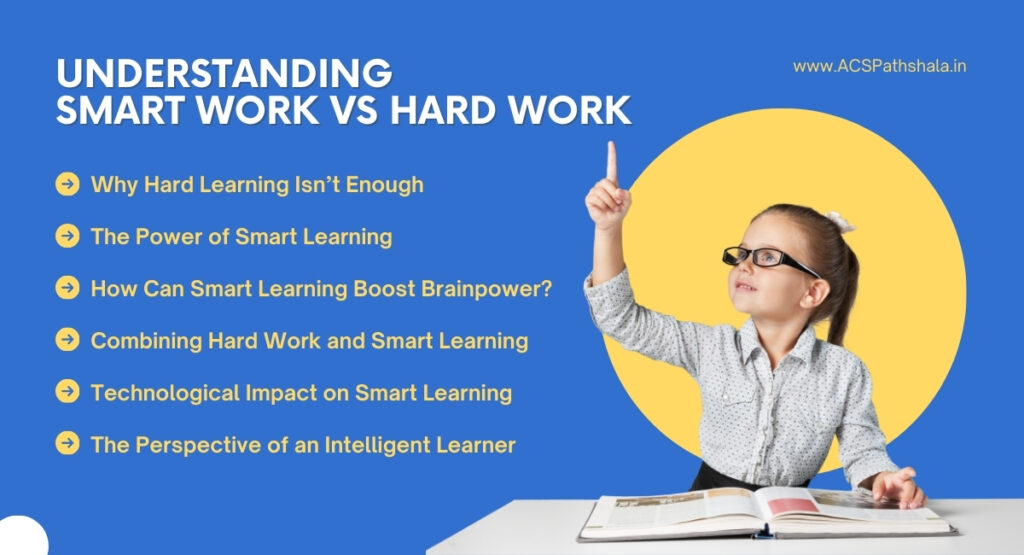
Why Hard Learning Isn’t Enough
For decades, educational institutions have celebrated hard work. Students are pushed to study for longer hours, remember enormous amounts of knowledge, and depend largely on repetition. While this promotes discipline, it often ignores comprehension and application.
Students might spend hours learning concepts and equations, but without context or connection, they forget quickly. Understanding, not repetition, is remembered by the brain. That is why concentrating just on hard learning does not always result in progress.
Smart learning changes this process by providing structure and purpose to effort. It teaches the mind to operate efficiently and remember information effectively. This is where efficiency in learning comes into play. When you approach studies wisely, you maximize your time and energy while lowering stress.
The Power of Smart Learning
Smart learning is the secret to studying any topic in less time. Focus on channeling hard effort, not avoiding it. Wise learners value comprehension, practice, and reflection.
Instead of continuously reading a history chapter, a clever student may develop a timeline of events, relate them to causes and results, and then quiz oneself. Instead than tackling hundreds of comparable queries, mathematicians may investigate a handful exhaustively to understand the reasoning behind each step.
This strategy encourages students to remain involved, think critically, and build independence in their studies. When you study this manner, your learning efficiency automatically improves, and you begin to achieve goals faster since your time is spent where it is most needed.
How Smart Learning Can Help Expand Your Brain Power
Smart learning is essentially a collaboration with the brain to perform the task of memory by connecting the new information to the old one. Passive learning disappears pretty quickly, whereas understanding promotes longer retention.
Memory can be very weak, but it can also be very strong if it is backed by the right techniques: active recall, interval repetition, and idea arrangement are only some of these techniques, and they all utilize natural memory processes to improve one’s memory. Also, teaching others or summarizing in your own words strengthens memory even more.
Use metacognition to figure out your learning type, whether you are a visual, aural, or kinesthetic learner, and personalize your learning methods for maximum productivity, thus, reaching the total use of your potential with very little effort.
Combining Hard Work and Smart Learning
The main secret of real success is a mixture of both ways. Hard work gives a person consistency, discipline, and effort. Smart learning brings factors like direction, creativity, and awareness. The combination of these two creates a perfect growth formula.
Students can implement these strategies to merge the best of both:
- Plan before you study
Make it a point to have specific goals for every study session. Instead of just saying “I’ll study science today,” you could determine what chapters or concepts to work on.
- Work in focused sessions
Break your study time into smaller sessions with a short break between each. A concentrated thirty-minute session will be much more productive than three hours of studying while your mind is elsewhere.
- Understand before memorizing
Always try to understand the concept of the topic before memorizing it. When you understand, it is easier to remember and you become more confident.
- Test yourself regularly
Self-testing enables one to find out the difficult parts and, therefore, get better faster. The tool is Efficiency at learning, and it is very powerful indeed.
- Reflect on your progress
Regularly review your strategies and which ones performed best. Changes to your study regimen might keep you productive and motivated.
Dedication and guidance can help you reach your goals quickly. An equilibrium technique promotes motivation, reduces burnout, and fosters long-term success.
Technological Impact on Smart Learning
Modern technology makes smart learning simpler than ever. Online platforms, interactive classes, and personalised study programs help students prioritise. Video lectures, quizzes, and AI-based feedback enable immediate learning modifications.
Technology and personal coaching combine at ACS Pathshala. Individualised online coaching is tailored to each child’s pace, learning style, and objectives in school. Comprehension and confidence-building are taught. Students learn to study smarter and achieve better with personalised attention and disciplined tactics.
The Perspective of an Intelligent Learner
Smart learning goes beyond simply employing study techniques and involves the right mindset as well. Curiosity, adaptability, and growth characterize smart learners. They aim for development, not perfection. They make it a point to set goals, assess their level of performance, and keep their spirits up even when facing difficult situations.
A clever learner’s mentality is defined as follows:
- They want quality over quantity.
- They learn from their errors rather than fear them.
- They remain constant yet adaptable in their techniques.
- They accept responsibility for their learning path.
When this mentality is combined with consistent effort, learning efficiency increases and students begin to achieve objectives quicker than ever before.
Conclusion: Learn Smarter with ACS Pathshala
There is still a question in the debate of Smart work vs hard work, which is the winner? The truth is that success is really in a balance. Hard work is what makes the foundation; however, smart learning is what determines the height of the building. When students decide to understand the content instead of merely memorizing it, they enhance their learning Efficiency and start Achieving their goals faster with less stress and more joy.
At ACS Pathshala, we are committed to assisting each pupil in finding that equilibrium through personalized, one-to-one instruction. Our aim is to turn education into a time of understanding, rather than pressure. With the proper strategies and the right spirit, any learner can become a genius in studying smart and thus be able to convert their effort into excellence.