
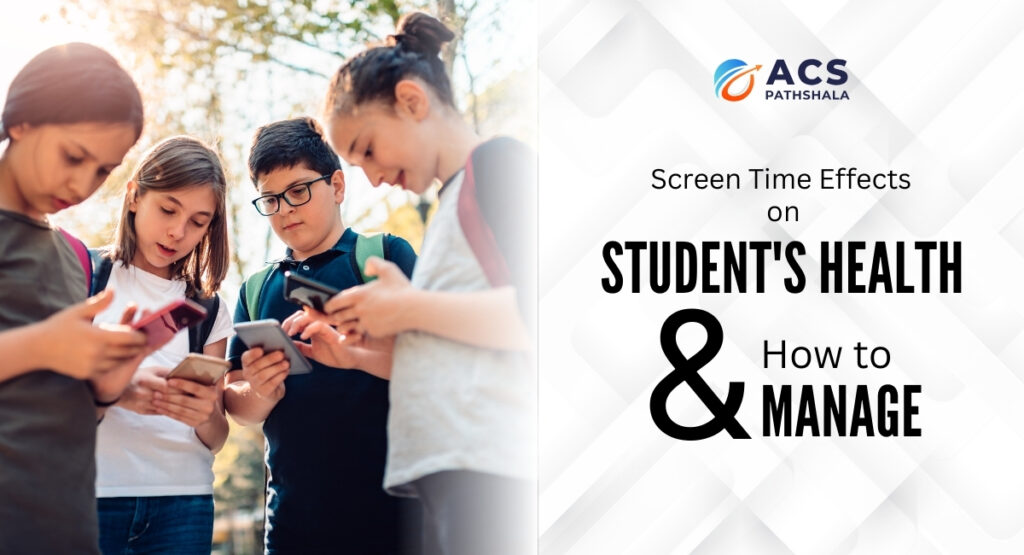
Screens have become a part and parcel of every student’s life. From attending virtual classes and completing homework to chatting with classmates and watching educational videos, digital screens are everywhere. While technology has made learning more accessible and interactive, it has also raised concerns about screen time effects on student’s health, highlighting the growing need to maintain a healthy balance between screen exposure and overall well-being.
At ACS Pathshala, we know that learning in the contemporary age relies on technology, yet it should always at no point cost health. That is why students need to comprehend the impact of screen exposure on student’s health and learn intelligent methods of tackling it. What we strive to achieve is not avoidance of technology, yet application of technology in a well-directed and intelligent manner.
Knowing the Development in Screen Time
It isn’t easy to even envision a screen-free day. Academic tasks, virtual classes, teaching videos, and even rest periods necessitate exposure to screens. Students spend several hours a day in front of screens. What previously was a convenient learning and communication assistant has become a subtle companion.
Technology simplified education, yet it also requires diligence. Just as computer-based learning keeps students up-to-date and in-touch, overuse has side-effects on concentration, posture, and sleeping patterns. Early identification of this marks the beginning of screen time effects on student’s health in the right direction.
The Physical Implications of Too Much Screen Time
Physical discomfort is one of the most visible effects that can be observed after prolonged screen exposure. Students are constantly reporting that they have headaches, dry eyes or neck pain after they have been on their phones or laptops for a number of hours. These are not just random pains but indications from the body.
Working eyes become one of the biggest victims. The blue light given off by the screen is making the eyes work harder to focus, thus leading to dryness and irritation. In addition, long screen use encourages bad posture, thus resulting in shoulder and back pain. Staying too long in one place decreases your body’s physical activity, which, in the long run, is likely to cause tiredness and weight gain.
On top of that, a lot of screen time is often associated with not enough sleep. Quite a number of students turn to their gadgets just before sleep and the bright light delays the body’s natural sleep cycle. This, over time, may cause lack of energy, poor concentration, and even changes in emotional state. Knowing how screen time affects student’s health is a way for parents and teachers to help the kids develop good habits.
The Mental and Emotional Impact
The impairment of screens is not limited only to the physical health of the body. It changes the way students think, feel, and behave very significantly. A never-ending exposure to social media and digital entertainment can make the mind very restless and it keeps it distracted.
Excessive screen time usually limits real-world interactions. Students may end up comparing their lives with those of others on the internet which may cause them to have anxiety, feelings of insecurity, or low self-esteem. The continuous notifications and the never-ending scrolling also make it difficult for the students to concentrate and this is why their attention span becomes shorter.
This is the reason why screen time effects on student’s health is not just a matter of physical necessity only. It is also about emotional stability and mental peace. A healthy balance gives students a chance to use the internet in a way that is beneficial to them and not to fall into the trap of digital fatigue, which is quite common nowadays.
How Screen Time Affects School Performance
Screens are excellent learning aids, primarily if one uses them judiciously. If students end up watching meaningless videos for a long time or keep switching between programs, it becomes ever more hard to concentrate on academics.
Overuse of the devices affects memory and reasoning. Multitasking between study and entertainment reduces attention span and productivity. A tired or distracted mind can hardly learn effectively.
At ACS Pathshala, we make sure that students are taught to employ technology as a support mechanism and not as a distraction. Proper handling of screen time allows students to excel academically while possessing clear minds and learning motivation.
Empowering Strategies for Digital Balance
- Create screen-free areas, such as meal times or bedtime hours to rest your eyes and mind, and use the 20-20-20 rule by looking 20 feet away for 20 seconds every 20 minutes to relieve eye stress.
- Create a study schedule with breaks to maximize productivity and schedule physical activities such as playing outside or doing yoga for a body reset.
- Ban devices at night to safeguard sleep quality from blue light, and be attentive by choosing educational content instead of continuous scrolling.
- Utilize tracking apps to track usage, turning screens away from sources of fatigue into instruments of empowerment for mind and body health.
Inviting Parents and Teachers to Assist
Parents and teachers can also assist students in these digital experiences. They help guide them towards healthier screen usage habits. Having reasonable rules at home as well as encouraging digital-free family activities does a great deal of good. Teachers can also give small breaks between online activities to minimize the digital burden.
We aid parents and teachers with methods that ensure balanced digital learning. Our one-to-one online tutoring is centered on customized interaction instead of incessant screen time. This keeps students active and alert without leaving them exhausted.
A Balanced Approach to the Digital Future
Technology itself is not the villain; the problem is an imbalance. If children are allowed to use their devices correctly, then the screens can be a source of creativity, connection worldwide, and unlimited learning. The aim of the game is not to remove the devices but to have them working for the students rather than against them.
Through the development of awareness and the observance of simple habits, pupils are able to keep up their academic progress as well as their physical health. They are able to learn, investigate, and communicate, and at the same time, they can have their portion of rest, introspection, and experiences from the real world.
Conclusion: Learn Better with ACS Pathshala
The world online is here to stay, yet how we employ it determines our well-being. Becoming aware of the screen time effects on student’s health is the beginning step towards a healthy life. When students give emphasis to conscious habits, sports, and sleep, they develop a lifestyle that can enable learning and contentment.
At ACS Pathshala, we also think that intelligent learning can go hand in hand with self-caring. Our model combines technology with personal guidance, encouraging students to stay motivated without compromising on balance. With the appropriate direction and awareness, success is accessible to any learner while keeping a sound mind and body — a harmonious union between learning and life in the digital world.