
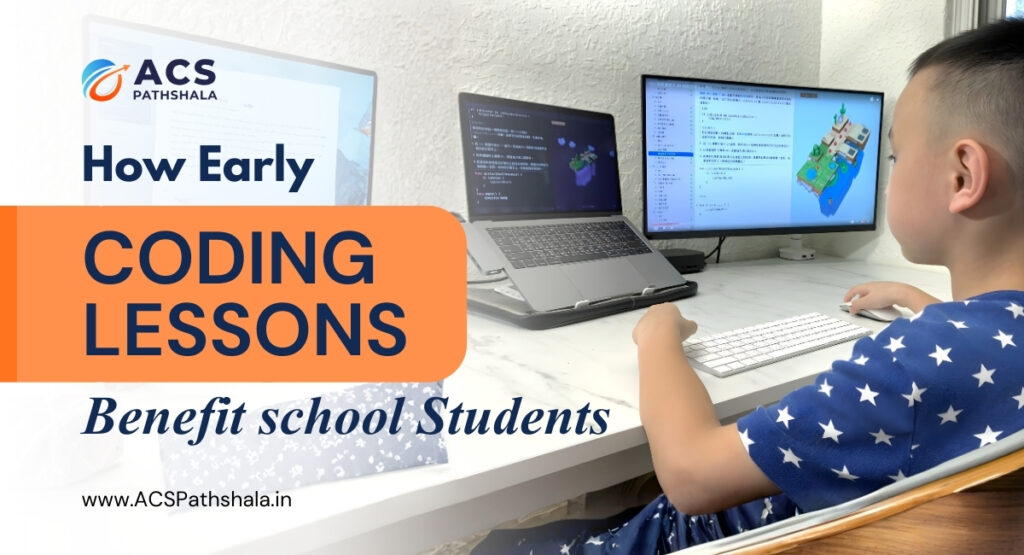
Have you considered how early coding courses might impact a child’s future? In a world of apps, automation, and AI, technological knowledge is important. The early coding lessons benefit help kids develop logic, creativity, and digital fluency. When children learn to code from an early age, they don’t just work with technology—they learn to build it.
At ACS Pathshala, an online learning platform that strives to make students competent with future-ready skills, coding instruction is considered the most important breakthrough that leads to innovation and success in the early years. By a series of carefully planned lessons and individual instruction, ACS Pathshala makes sure that each student is not only able to code but also understands the coding process.
Why Should Students Learn Coding Early in School?
Learning to program early may appear innovative, but the results speak for themselves. The benefits of coding education for pre-teens extend far beyond the technical—it changes children’s thinking patterns, problem-solving skills, and learning style. Let’s talk about the top ways that these classes enrich a child’s intellectual and personal development.
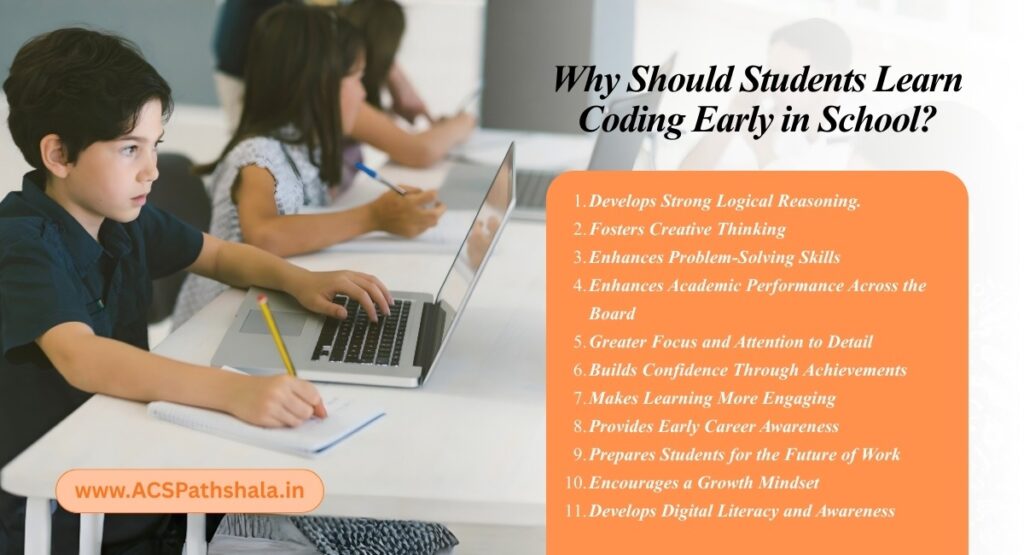
1. Develops Strong Logical Reasoning
One of the largest coding benefits for students in schools is how coding enhances logical and analytical thinking. Coding creates sequences that need to be followed, problems that need to be recognized, and a step-by-step thought process in order to solve them.
- Students gain patience and tenacity via the process of debugging faults that they have made.
- Coding teaches one how to decompose big problems into small, manageable steps.
- Logical thinking that is gained through coding also improves math and science achievement.
2. Fosters Creative Thinking
Coding is not merely about commands—it’s creativity. Students have the opportunity to create stories, animations, and basic games, bringing abstract ideas to life.
- Coding gives students permission to freely test out ideas and bring new thoughts to life digitally.
- Getting a head start makes them view technology as a canvas for creativity, not just something they use.
- They encourage imagination and provide windows of opportunity for innovation early in life.
3. Enhances Problem-Solving Skills
The Early Coding Lessons Benefit students through enhancing their capacity for problem-solving and analysis. Each coding project has some issues, and solving them helps students to think critically.
- They learn to recognize several solutions to a problem, and this builds the flexibility of thought.
- This attitude easily flows into real life, and students make logical decisions.
- Through time, the students become resilient and assured in confronting any challenge.
4. Enhances Academic Performance Across the Board
Coding is not just for computer science—it improves performance in other subjects as well.
- Mathematics is more interesting when logic and algorithms are used in coding tasks.
- Students enhance their reading and writing skills through comprehension of syntax and structure.
- They learn to follow patterns, sequences, and structures of problems—essential skills in all subjects.
The early coding education dividends have far-reaching implications beyond screens—they assist students in thinking smarter in all disciplines.
5. Greater Focus and Attention to Detail
Coding requires focus and accuracy. Omitting a single character can result in a program’s failure, which instills attention to details in students.
- This attention to detail carries over to academics as improved attention.
- They learn the importance of accuracy and double-checking prior to submission.
- The process also teaches discipline and how to manage time.
This attention to detail serves them well when solving intricate problems in their higher studies and professional lives.
6. Builds Confidence Through Achievements
There is no greater inspiration for a young student than watching their project unfold.
- Having completed a coding assignment, a feeling of pride builds confidence.
- It makes students bold and willing to try things out without fear of making mistakes, as all mistakes are a step towards learning.
- Coding’s observable results make learning concrete and satisfying.
Confidence gained with small successes in coding tends to translate to other aspects of life.
7. Makes Learning More Engaging
Coding makes learning an engaging experience.
- Students are thrilled when they develop their own apps, games, or digital tales.
- It converts passive learners to active learners who are in control of their learning process.
- This active participation raises curiosity, and they tend to dig deeper into technology.
When learning is a fun experience, knowledge retention automatically increases.
8. Provides Early Career Awareness
Early introduction to coding also enables students to find out about their interests in tech careers.
- They become aware of areas such as software development, robotics, game design, and data science.
- They have an idea of direction towards future endeavors through their understanding of how digital tools function.
- It develops an innovative mindset that fits today’s employment market.
They are more capable of thriving in a digital economy when they comprehend technology early on in life.
9. Prepares Students for the Future of Work
The benefits of coding for school students are directly related to future employability. Every sector now—healthcare or entertainment—depends on technology.
- Early coding skills put them ahead of the curve when it comes to grasping automation and artificial intelligence.
- They learn to adapt as they can easily learn new digital tools.
- These are skills that keep them relevant in a constantly changing professional environment.
Coding does not only instill technical expertise, but also flexibility—the most valuable asset for success in the future.
10. Encourages a Growth Mindset
Coding inescapably teaches students that mistakes are an integral part of learning.
- Debugging mistakes or testing software demonstrates that errors can be corrected with effort.
- This experience inculcates a healthy, growth-mindset.
- Students no longer dread obstacles and start perceiving them as chances to get better.
Early development of a growth mindset allows people to achieve academically, at work, and in life.
11. Develops Digital Literacy and Awareness
Aside from computer skills, coding educates students on the digital world responsibly.
- They understand how sites, apps, and algorithms work, making them aware of digital systems.
- It also makes them more vigilant regarding online privacy and ethical technology usage.
- This awareness makes them become mature digital citizens with a sense of responsibility.
In a world where technology is omnipresent, such digital literacy is a huge plus.
Conclusion: Building a Smarter Future with ACS Pathshala
Creators, inventors, and thinkers will shape the future, and early coding training prepare them. Early Coding Lessons teach youngsters logic, creativity, and confidence for a tech-driven future. Early coding instruction also improves communication, collaboration, and academic performance, preparing pupils for lifetime success.
In ACS Pathshala, coding isn’t another subject; it is a skill that allows students to think differently, solve real problems of the real world, and craft their own future in the world of technology. Through expert teachers and hands-on learning, ACS Pathshala allows young minds to discover the limitless potential of technology and achieve success with confidence.