
Have you observed that some kids prepare for hours yet fail board exams? Students’ unintentional board test blunders can make the difference.
Many students repeat the same board exam mistakes every year, creating stress, inadequate review, and poor test outcomes. Better still, these mistakes are avoidable. A good learning strategy and board exam study recommendations may help students prepare, consolidate, and perform effectively.
Experienced professors at ACS Pathshala emphasize idea clarity, disciplined preparation, and savvy test techniques. Students may avoid typical board exam blunders and strengthen their intellectual foundations with this assistance.
Board examinations need more than chapter memorization. They assess comprehension, consistency, and application. Early detection of typical board exam preparation faults helps students manage their studies.
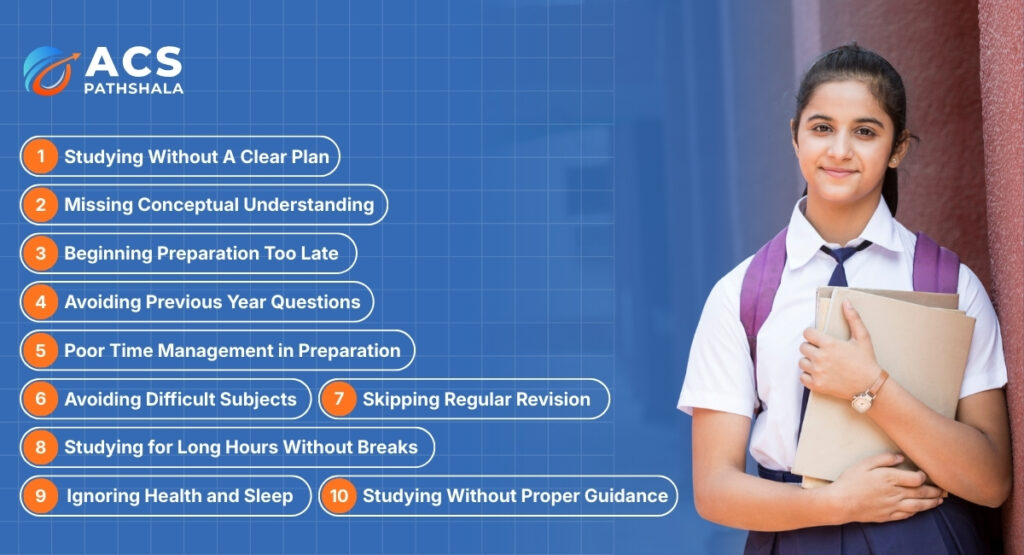
Here are 10 board exam preparation pitfalls and how to prevent them.
- Studying Without A Clear Plan
One of the most frequent board exam mistakes students make is failing to arrange their study time. Many students begin reading things at random, without first structuring their curriculum or setting a study regimen.
Without a defined strategy, students sometimes squander important time determining what to study next rather than concentrating on learning.
- How To Avoid This
Create a realistic study schedule that covers all courses. Divide chapters into smaller subjects and set out defined time windows for learning, practice, and review.
Planning allows pupils to remain consistent and handle their coursework properly. Following an organized timetable is one of the most efficient board exam study strategies for finishing the curriculum with ease.
- Missing Conceptual Understanding
Another major mistake in board exams is focusing on memory rather than conceptual understanding.
Of course, memorizing definitions is useful, but application and conceptual understanding are what are tested in exams.
- How to Avoid This
Focus on the logic behind each concept. Once the concept is understood, doing problems becomes easier.
Gain a better understanding of complex concepts by practicing with numerical puzzles, case studies, and analytical issues.
- Beginning Preparation Too Late
Most students delay their preparation until the dates of the exams have been announced. This is one of the biggest blunders in board exam preparation.
- How to Avoid This
Start your preparation at the beginning of the academic session. It will help you avoid cramming and anxiety.
Study habits throughout the academic session are one of the best board exam preparation tips.
- Avoiding Previous Year Questions
One of the pitfalls in preparing for board examinations is to restrict your practice to just textbook problems.
This is where studying past year questions is important. Without this, one will not get a real understanding of how questions are set.
- How To Beat It
Studying past year questions is important. This will not only show you which areas are important but will also improve your ability to write exact answers. It will also improve your time management skills. This will definitely boost your confidence and improve your scores.
- Poor Time Management in Preparation
Poor time management is another common mistake that is seen in the board exams for many students. Some students may devote too much attention to one topic and overlook others.
- How to Avoid This
Organise study time for each course based on its complexity level and syllabus size. Difficult subjects may necessitate greater attention, but all subjects should receive constant practice.
Adequate preparation allows kids to remain organised and confident.
- Avoiding Difficult Subjects
Many learners opt to study things they love rather than tough issues.
While this strategy seems comfortable at first, it ultimately becomes one of the major board exam preparation blunders.
- How To Avoid This
Begin the time you spend studying with the most challenging topic when you are most focused.
Divide complicated chapters into smaller parts and practise them gradually.
Address difficult topics early boosts confidence and reduces test anxiety.
- Skipping Regular Revision
Revision is an important part of the learning process, but is also the part most likely to be ignored. Revision is often seen as an optional part of the learning process, especially as the board exam approaches.
- How to Avoid This
Make a weekly revision schedule. Revisiting subjects helps pupils improve their recall and find areas for improvement.
Regular review remains one of the most important board exam study strategies for good knowledge retention.
- Studying for Long Hours Without Breaks
It is a common notion that burning the midnight oil and working for hours will result in better results. However, in most cases, it results in fatigue and a lack of concentration.
- How to Avoid This
Implement scheduled study times, such as 45 minutes of serious studying followed by a brief rest.
Short breaks rejuvenate the mind and help you concentrate throughout the following study session.
Retaining energy and concentration is critical for successful preparation.
- Ignoring Health and Sleep
One of the common pitfalls that students face while appearing for their board exams is the ignorance of their health while preparing for their exams. Most students reduce their sleep hours and even skip their meals to have more time to study, but this is where they go wrong, as a tired mind is not able to focus properly, nor is it able to retain what it studies.
Smart Approach
Maintain a good sleep, diet, and water schedule. A relaxed mind can concentrate, absorb topics, and do better on examinations.
Maintaining academic performance requires physical and mental health.
- Studying Without Proper Guidance
Many students face challenges in certain topics but hesitate to seek help. This may cause you to take longer to learn and may lead you to commit the same blunders in the board exams.
- How to Avoid This
You should seek help from experienced teachers who can guide you through the concepts in an easy manner and also help you learn effective ways to learn.
At ACS Pathshala, you can seek academic guidance from experienced teachers who can help you learn concepts in an easy manner and also guide you through effective ways to learn for the board exams.
Smart Board Exam Study Tips by ACS Pathshala
Avoiding errors is simply one aspect of efficient preparation. Students must also use learning tactics to increase productivity and confidence.
Here are some realistic board exam study tips that successful students use.
- Practice writing answers
Board examinations demand well-structured written responses in a restricted amount of time. Regular writing practice improves both speed and presentation.
- Focus on strong-weight topics
Identify the chapters with the highest mark evaluation and ensure enough planning.
- Use active learning techniques
Methods include summarizing notes, answering practice problems, and explaining topics to others to improve comprehension.
- Maintain consistency
Strengthening long-term learning is the result of consistent everyday study.
The most successful and targeted preparation for the board exam is achieved when students apply these tactics in conjunction with knowledge of typical board test blunders.
Synopsis
Success in board examinations is not about studying more, but about avoiding typical board test blunders and refining your strategy. When students recognize critical board exam preparation mistakes and use the proper tactics, their confidence and performance automatically increase.
With the correct advice, constant practice, and tried-and-true board exam study techniques, getting better outcomes is much simpler.
ACS Pathshala provides students with experienced coaching, disciplined learning, and clever tactics to help them avoid errors and succeed in tests.